
2025 saw the driest spring and summer (March to July) since 1921 across parts of England. And July 2025 was the equal fifth warmest July in England, since records began in 1884. Reservoir levels dropped dramatically. Water stocks across England in early August were 67.7%, with some reservoirs falling as low as 39%, according to Gov.uk.
With climate change showing no signs of easing, 2025 won’t be the last dry summer we have. We might be facing dry summers every year.
But it is possible to maximise water savings at home by harvesting rainwater during the wet weather. It also means you can continue to water your garden, even when the water companies introduce a hosepipe ban!
Rainwater harvesting helps to:
- Reduce pressure on local drainage networks
- Reduce the risk of surface water flooding
- Make savings on your bills at home without needing to cut back on water use
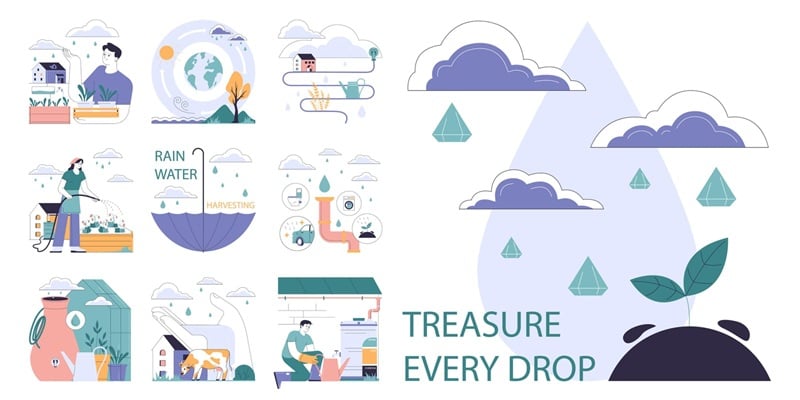
Rainwater harvesting involves collecting and storing rainwater for when it is needed, reducing your reliance on mains water and promoting sustainable water management. It provides access to an independent water source for gardening, toilet flushing, car washing and other outdoor uses.
(Rainwater harvesting definitely isn’t for drinking water, unless it is properly treated!)
Methods for rainwater conservation include traditional barrel systems and large cisterns. Barrel systems collect rainwater from rooftops, while cisterns store large quantities for extensive reuse.
A well-functioning rainwater harvesting system consists of several essential parts, which all play a role in ensuring efficient rainwater capture, storage and reuse.
Gravity-fed systems use gravity to direct rainwater into storage tanks without electricity, while direct pumped systems provide high-pressure water delivery, which is suitable for domestic use and adapts to varying rainfall levels.
The catchment area is where the rain is first collected. At home, this is most likely to be the roof. Not only does your roof provide a large surface on which to collect water, it also provides the best opportunity to collect relatively uncontaminated rainwater before it reaches the ground.
Rainwater harvesting involves directing the rainwater from the roof through gutters and downpipes into a storage tank. This sort of rainwater harvesting works best with sloped roofs for efficient water flow.
The volume of rainwater that can be collected - known as the collection potential - depends on several factors, including roof material and roof pitch. A pitched domestic roof has a collection potential as high as 90%.
Knowing how much runoff you are likely to get from your roof is essential when calculating how much rainwater you could harvest and sizing the main storage tank. Getting the tank size right can support long-term, reliable water savings.
For your rainwater harvesting system to work effectively, gutters should be clear of debris to prevent blockages.
Before entering the storage tank, rainwater is channelled through a pre-tank filter. The British standard for rainwater harvesting filters is a mesh with holes of 1mm. This is designed to stop leaves and other debris from getting into the tank and compromising water quality. Around 90% of the rainwater coming off the roof will get through the filter and into the storage tank, with the remaining 10% carrying debris diverted to the drain.
Collected rainwater is stored in a dedicated storage tank, which may be above ground or below ground, depending on available space, site constraints and what the water is to be used for.
If you are using your harvested rainwater to flush toilets, submersible pumps inside the tanks will transfer rainwater into a piping system into your home, ready to use.
To make sure you are getting maximum benefits from your rainwater harvesting, it is essential to maintain your tank regularly:
- Check gutters and downpipes for blockages
- Clean filters regularly
- Check storage tanks for leaks or contamination.
- Flush the system every now and then to prevent stagnation
Tanks are typically sized to ensure sufficient supply to meet non-potable water demand during periods of low rainfall, while also balancing cost, available space and yield efficiency.
Tanks for Everything stocks water tanks from 150 litres to 30,000 litres. Non-portable water tanks - where the water is not intended for drinking, food preparation or personal hygiene - are suitable for rainwater harvesting, grey water storage and water storage for irrigation. All tanks should be fitted on a solid base which fully supports the base of the tank.
Why let precious rainwater go to waste when you can capture it for later use? Whether it’s a simple tank for watering your garden or something more advanced, rainwater harvesting can maximise your water savings at home.